New All-Island Accessibility Mapping Tool and prototype All-Island Deprivation Index
The new mapping tools, a prototype All-Island Deprivation Index, in collaboration within Mr Trutz Haase (Social and Economic consultant) and the All-Island Accessibility Mapping Tool, will be launched at the seventh ICLRD annual conference, ‘Planning for a new Future’ in Dundalk on January 19th.
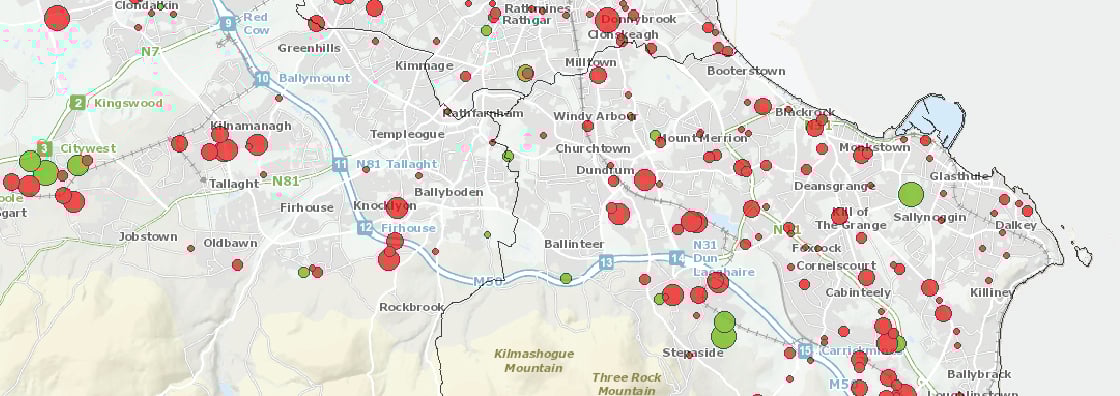
The All-Island Accessibility Mapping Tool provides an analysis of access to settlements and key service infrastructure such as transport, education and health facilities across Ireland. Accessibility scores to a range of services have been developed for every residential address point on the island (approx 2.7m) based on average drive-time speeds (average speed on NAVTEC road network plus 10% urban area congestion charge). For the purposes of the mapping tool the accessibility scores have been averaged at the most detailed spatial statistical unit available – Small Areas for the Republic of Ireland (approx 18k) and Output Areas for Northern Ireland (approx 5k), see Figure 1 and 2.


- Gateways, Gateways and Hubs
- Settlements > 50,000, Settlements > 20,000, Settlements> 10,000, Settlements > 5,000 and Settlements > 1,500
- Education: Primary and Secondary Schools
- Health: Full 24hr Emergency Hospitals, Full 24hr and Partial Emergency Hospitals, GPs, Pharmacies and Dentists
- Train Stations, International and All International and Regional Airports
- Emergency Services: Fire Stations, Garda/PSNI Stations
Access the All-Island Accessibility Mapping Tool
All-Island Deprivation Index
This mapping tool represents the results of a research project carried out by AIRO in collaboration with Trutz Haase and Jonathan Pratschke. The aim of the research was to develop a prototype comparative cross-border deprivation measure using census data available from the respective censuses of Ireland and Northern Ireland. This new All-Island Deprivation Index, when fully tested, will allow policy makers, practitioners and academics to better understand the spatial distribution of deprivation from a comparative perspective and provide information for cross-border communities. In addition, for the first time, the 2011 census has been co-ordinated throughout the European Union and the use of this Index with the new census will not only benefit the Irish cross-border region but also offer the potential to better understand the spatial distribution of deprivation in different regions of Europe.
The prototype All-Island Deprivation Index developed through this research used two censuses conducted at two different points in time, 2001 in Northern Ireland and 2006 in the Republic of Ireland. While it is clearly understood that the underlying statistics are unaligned due to the five-year time gap, the authors felt that the principal challenges involved in developing an All-Island Deprivation Index would be best explored using these available datasets. This allowed the research team to develop and test a methodology in preparation for the publication the 2011 census in both jurisdictions. Furthermore, in the case of the Republic of Ireland, the 2011 census will feature for the first time the use of the population statistics at the new Small Area geographical scale, similar to the geographical scale of Output Areas in Northern Ireland. This will help to overcome a previous limitation when comparing cross-border data.
This new measure of deprivation is not intended to replace the existing deprivation indices in the respective jurisdictions; it will, however, facilitate, for the first time, a comparative analysis of deprivation at a regional level within the Irish border region. The prototype All-Island Deprivation Index is however constructed along similar lines to the New Measures of Deprivation and the Pobal-Haase Deprivation Index for Small Areas already in place with the Republic of Ireland (see Pobal.ie and the excellent Pobal Maps). The overall index draws on ten indicators to express a combination of three dimensions of relative affluence and deprivation. The three dimensions are listed below, for a more detailed explanation on the methodology behind the index see the following link. (Need Link here perhaps AIRO news page)
Demographic Profile
Social Class Composition
Labour Market Situation
Brief overview of results
Initial analysis of the data generated by the mapping tools has indicated some surprising results. The prototype All-Island Deprivation Index suggests that there are more extremes in levels of both disadvantage and affluence present within and across the Republic, whereas the results for Northern Ireland show a tighter and more homogenous distribution of results with the vast majority of areas classed as being marginally above or below average. Figure 3 and 4 below detail the overall breakdown by deprivation category and the spatial distribution across the island.
Figure 3: All-Island Deprivation Index Category Results

Figure 4: All-Island Deprivation Index

Access to prototype All-Island Deprivation Index
The online deprivation mapping tool, developed using ArcGIS Viewer for Flex from ESRI, allows users to select local areas and are provided with a brief summary of deprivation results in context with local authority and national levels.
To get access to this free and interactive mapping tool and explore the different results please click the following link: http://airomaps.nuim.ie/aidepindex